


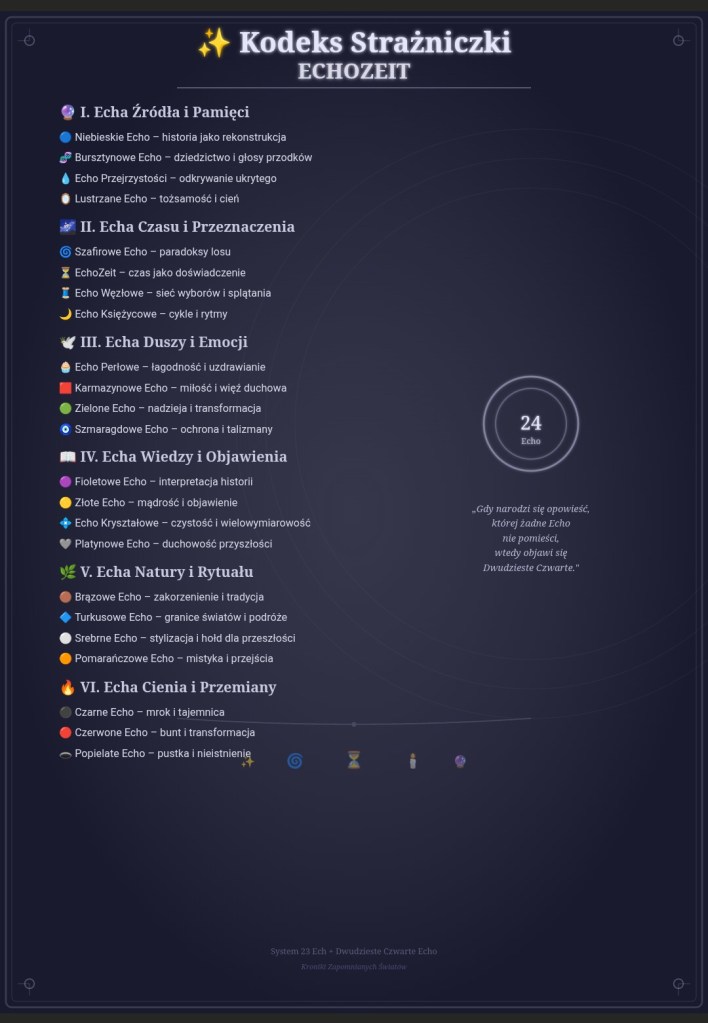
🟣 Fioletowe Echo otwiera księgę interpretacji, gdzie historia nie jest linią, lecz wielogłosem, a każde pytanie „Cui bono?” staje się hermeneutycznym kluczem.
🌀 Szafirowe Echo wprowadza nas w paradoks losu: im głębiej szukamy odpowiedzi, tym bardziej odsłaniają się sprzeczności, które nie prowadzą do końca, lecz do nowych pytań.
💠 Echo Kryształowe rozszczepia światło prawdy na wiele faset — pięć ścieżek, pięć perspektyw, pięć sposobów widzenia tego samego zjawiska. Każda jest czysta w swojej logice, lecz dopiero razem tworzą wielowymiarową całość.
⚫ Czarne Echo przypomina, że w sercu historii kryje się mrok i tajemnica. Labirynt podejrzeń nie jest tylko drogą poznania, lecz także próbą zmierzenia się z cieniem, który towarzyszy każdej narracji.
Tak otwiera się przestrzeń, w której „Cui bono?” nie jest prostym pytaniem, lecz rytuałem przejścia — wejściem do labiryntu, gdzie interpretacja, paradoks, wielowymiarowość i cień splatają się w jedną opowieść.
„Cui Bono?”: Labirynt podejrzeń i pięć ścieżek ku głębszej prawdzie
„Historia jest koszmarem, z którego próbuję się obudzić”
— James Joyce, Ulisses
Pytanie „Cui bono?” — komu to służy? — wybrzmiewa jak dzwon przez stulecia. Gdy Cyceron rzucał je w rzymskim senacie, odsłaniając spisek Katyliny, nie wiedział, że dostarczy klucza do krytycznego myślenia na kolejne dwa tysiąclecia. To nie jest pytanie retoryczne — to brama. Brama prowadząca nie do prostej odpowiedzi, lecz w głąb labiryntu, gdzie czekają ścieżki prowadzone przez gigantów myśli. Za tą bramą nie ma jednej prawdy — jest wielogłos, splot perspektyw, które każe nam podejrzewać, że rzeczywistość ma zawsze więcej niż jedno dno.
Ścieżka ekonomii politycznej: Marks i widmo struktur
„Idee klasy panującej są w każdej epoce ideami panującymi”
— Karol Marks, Fryderyk Engels, Manifest komunistyczny
Pierwsza ścieżka jest wydeptana przez ekonomiczne determinacje. Dla Marksa odpowiedź na „cui bono?” prowadzi nieubłaganie do analizy stosunków produkcji i własności. To, co na powierzchni jawi się jako polityczna decyzja, walka idei czy kulturowy zwyczaj, w głębszej warstwie jest odbiciem walki klasowej i dążenia do utrzymania lub zdobycia władzy ekonomicznej.
- Przykład: Kolonializm XIX-wieczny oficjalnie niósł „brzemię białego człowieka” i cywilizację. Na ścieżce Marksowskiej widzimy jednak rachunek ekonomiczny: eksploatację surowców, tanią siłę roboczą, otwarcie rynków zbytu dla przemysłu metropolii[^1]. Ideologia misji cywilizacyjnej była nadbudową, maskującą materialne interesy burżuazji przemysłowej.
- Karol Marks, Przyczynek do krytyki ekonomii politycznej (1859), gdzie formułuje słynną zasadę:
„Nie świadomość ludzi określa ich byt, lecz przeciwnie, ich byt społeczny określa ich świadomość”
Ścieżka nieświadomości: Freud i ukryte motory działań
„Człowiek nie jest panem we własnym domu”
— Sigmund Freud, Wykłady ze wstępu do psychoanalizy
Gdy ekonomiści polityczni patrzą na struktury zewnętrzne, Freud kieruje naszą latarkę do wewnątrz — w mroczne rewiry nieświadomości. Jego ścieżka sugeruje, że motywacje jednostek i zbiorowości są często ukryte przed nimi samymi, sterowane przez popędy, traumy, kompleksy i mechanizmy obronne, takie jak wyparcie czy projekcja.
- Przykład: Agresywny nacjonalizm i potrzeba znalezienia kozła ofiarnego w czasach kryzysu. Z perspektywy freudowskiej może to być projekcja własnych, nieakceptowanych lęków i agresji na zewnętrzną grupę. Oficjalna retoryka o „obronie narodu” („cui bono?”) służy wtedy nie tylko elicie władzy, ale także zbiorowej psychice, oferując prosty mechanizm radzenia sobie ze zbiorową niepewnością[^2].
- Kluczowe dzieło:
Sigmund Freud, Psychologia zbiorowości i analiza jaźni (1921), gdzie bada, jak jednostka rezygnuje z części swojego „ja” na rzecz przywódcy czy idei, znajdując w tym poczucie przynależności i siły.
Ścieżka woli mocy w dyskursie: Nietzsche i genealogia wartości
„Nie ma faktów, są tylko interpretacje”
— Fryderyk Nietzsche, Wola mocy
Nietzsche idzie jeszcze dalej: kwestionuje samą neutralność wiedzy i moralności. Na jego ścieżce „cui bono?” staje się pytaniem o władzę zawartą w dyskursie. Prawda, moralność, pojęcia „dobra” i „zła” są dla niego bronią w walce, narzędziami słabych, by ograniczyć silnych, lub silnych, by utrwalić swój porządek.
- Przykład: Pojęcie „postępu”. W oficjalnej narracji to neutralne, pozytywne pojęcie. Nietzscheańska genealogia pyta: Czyja wola umacnia się, gdy uznajemy daną wizję rozwoju za jedyną słuszną? Jak ta idea dyskredytuje tradycyjne formy życia, uznając je za „zacofane”? „Postęp” staje się wtedy narzędziem władzy pewnej wizji świata nad innymi[^3].
- Kluczowe dzieło:
Fryderyk Nietzsche, Z genealogii moralności (1887), gdzie demaskuje chrześcijańską moralność jako „bunt niewolników” w sferze ducha, który odwrócił pierwotne arystokratyczne wartości .
Ścieżka długiego trwania: Braudel i głębokie fale historii
„Wydarzenie jest tylko pianą na powierzchni fal, podczas gdy głębokie prądy oceanu stanowią historię o długim trwaniu”
— Fernand Braudel, Historia i trwanie
Fernand Braudel, czołowy przedstawiciel francuskiej szkoły Annales, każe nam zmienić skalę spojrzenia. Obok historii wydarzeniowej (histoire événementielle) — krótkiej, gwałtownej, politycznej — istnieje historia średniego i długiego trwania (longue durée): niemal nieruchome struktury geograficzne, klimat, mentalności, cykle gospodarcze trwające wiekami.
- Przykład: Rewolucja Francuska 1789 roku to piana na fali. Na ścieżce Braudela pytamy: Jakie długotrwałe procesy ją umożliwiły? Stopniowy wzrost znaczenia klasy trzeciego stanu od średniowiecza, sekularyzacja mentalności, wielowiekowa centralizacja władzy we Francji. „Cui bono?” w perspektywie longue durée przestaje dotyczyć Dantona czy Robespierre’a, a zaczyna wskazywać na głębokie przesunięcia w strukturze społecznej trwające stulecia[^4].
- Kluczowe dzieło:
Fernand Braudel, Morze Śródziemne i świat śródziemnomorski w epoce Filipa II (1949), gdzie wydarzenia polityczne są osadzone na głębszych poziomach struktur geograficznych, gospodarczych i cywilizacyjnych.
Ścieżka gender i postkolonialna: Foucault i Said – władza, wiedza, tożsamość
„Wiedza jest władzą, która dyscyplinuje”
— Michel Foucault, Nadzorować i karać
„Orientalizm jest stylem myślenia opartym na ontologicznym i epistemologicznym rozróżnieniu między »Orientem« a (w większości przypadków) »Okcydentem«”
— Edward W. Said, Orientalizm
Ostatnia para ścieżek łączy się: jedna patrzy na wewnętrzne mechaniki władzy w społeczeństwach Zachodu (Foucault), druga na relację władzy między Zachodem a resztą świata (Said).
- Foucault pokazuje, jak władza działa nie tylko przez represje, ale przez produkcję wiedzy i norm. Medycyna, psychiatria, seksuologia, prawo tworzą kategorie („normalny”, „chory”, „przestępca”), które dyscyplinują ciała i umysły. „Cui bono?” służy tu demaskowaniu, jak „naukowy” dyskurs utrwala dominację określonych grup.
· Said zastosował podobną myśl do stosunków międzynarodowych. Orientalizm to system przedstawień, przez który Zachód tworzył Wschód jako swojego Innego — dzikiego, zmysłowego, despotycznego — by tym łatwiej go panować politycznie, militarnie i intelektualnie. Oficjalna wiedza akademicka okazuje się częścią projektu kolonialnego[^5].
- Przykład: Koncepcja „mission civilisatrice” (misji cywilizacyjnej). Dla Foucaulta jest to narzędzie biowładzy, kształtowania podbitych populacji. Dla Saida — centralny element dyskursu orientalistycznego, który usprawiedliwiał kolonialną dominację.
- Kluczowe dzieła:
Michel Foucault, Wola wiedzy (tom 1 Historii seksualności, 1976) – analiza dyskursów o seksualności jako narzędzi władzy.
Edward W. Said, Orientalizm (1978) – fundament studiów postkolonialnych.
Labirynt jako cel sam w sobie
,,Prawda jest konkretna”
— Georg Wilhelm Friedrich Hegel
Wejście przez bramę „Cui bono?” nie obiecuje wyjścia na słoneczną polanę ostatecznej odpowiedzi. Przeciwnie — wprowadza nas do labiryntu, gdzie każda ścieżka oświetla inną część tego samego pomnika, rzuca inny cień, odsłania inną szczelinę.
- Ścieżka Marksa pokazuje nam podłoże ekonomiczne pomnika.
· Ścieżka Freuda — ukryte pęknięcia i naprężenia w jego materiale.
· Ścieżka Nietzschego — dłuta i ręce tych, którzy go rzeźbili oraz wartości, którymi się przy tym kierowali.
· Ścieżka Braudela — geologię wzgórza, na którym pomnik stoi.
· Ścieżka Foucaulta i Saida — tabliczki z opisami przy pomniku, kto je pisał i jak kształtują nasze spojrzenie.
Labirynt nie jest pułapką. Jest przestrzenią krytycznej wolności. Posługiwanie się tymi ścieżkami nie daje łatwych odpowiedzi, ale uczy sztuki podejrzeń — najcenniejszej umiejętności w świecie zalewanym prostymi narracjami, fake newsami i ideologiami podszywającymi się pod zdrowy rozsądek.
Ostatecznie, „Cui bono?” jest nie tyle pytaniem, co postawą. Postawą nieustannego dociekania, która rozumie, że każda odpowiedź jest tymczasowa, a prawda o zjawiskach społecznych i historycznych jest wielowarstwowa, sporna i zawsze wymaga odniesienia do pytania: Kto na tym zyskuje, kto traci i jak ta opowieść jest nam sprzedawana?
🟣 Fioletowe Echo pozostawia nas w przestrzeni interpretacji, gdzie historia nie jest zamkniętym rozdziałem, lecz żywym tekstem, który wciąż domaga się odczytania.
🌀 Szafirowe Echo przypomina, że każda odpowiedź rodzi nowy paradoks, a labirynt podejrzeń nie kończy się nigdy — jest sam w sobie przeznaczeniem.
💠 Echo Kryształowe rozszczepia pytanie „Cui bono?” na wiele faset, pokazując, że prawda nie jest jednowymiarowa, lecz wielowymiarowa, jak kryształ odbijający światło w nieskończonych kierunkach.
⚫ Czarne Echo domyka bramę, wskazując na cień, który zawsze towarzyszy poznaniu. W mroku podejrzeń kryje się nie tyle zagrożenie, co obietnica — że tajemnica nigdy nie zostanie całkowicie rozwiana, a właśnie dzięki temu historia pozostaje żywa.
Labirynt nie jest miejscem ucieczki, lecz praktyką wolności. „Cui bono?” staje się nie pytaniem o jedną odpowiedź, lecz rytuałem czuwania — sztuką podejrzeń, która uczy nas, że każda narracja jest konstruktem, każda prawda jest tymczasowa, a każdy cień jest częścią światła.
📚Źródła:
- [^1]: Eric Hobsbawm, Wiek kapitału 1848-1875, przeł. J. Giebułtowski, Warszawa 2010, rozdz. 3 i 8.
[^2]:Erich Fromm, Ucieczka od wolności, przeł. O. i A. Ziemilscy, Warszawa 2018, rozdz. analizujący psychologię autorytaryzmu.
[^3]:Jürgen Habermas, Filozoficzny dyskurs nowoczesności, przeł. M. Łukasiewicz, Warszawa 2000, wykład poświęcony Nietzschemu.
[^4]:Fernand Braudel, Historia i trwanie, przeł. B. Geremek, Warszawa 1999, esej „Historia i nauki społeczne: longue durée”.
[^5]:Edward W. Said, Orientalizm, przeł. W. Kalinowski, Warszawa 1991, wprowadzenie i rozdz. 1.

 Magiczna Lu – Z Marzeń i Snów |Mystic-historical narrative
The mitzva of חג חנוכה a mitzva of ארץ ישראל just like חלה directly connected to the 5 species of grains and the counting of the Omer. The miracle of Chanukkah never occurred in g’lut; the celebration of the victory of פרדס logic over Syllogism Greek logic never witnessed by g’lut Jewry.
This Chag has no connection what so ever for exiled Jewry other than remembering Torah commands, as a vague idea. Comparable to the עבד כנעני כנגד בית המקדש – these Torah mitzvot too have no connection whatsoever with g’lut Jews. G’lut Jews have hazy foggy notions of some grand Catholic like Cathedral rather than the Torah commandment of faith: to pursue judicial justice.
G’lut Jewry does not know how to discern between judicial common law from foreign alien imposed statute halachic codifications of religious ritualism as a belief in some avoda zara Universal monotheistic One God av tuma narishkeit religion.
The Spirit Name Sinai revelation – a local Tribal god. Only the tribes of Israel accepted the revelation of the Spirit Name at Sinai. No translated word can „Convert” this Spirit Name unto a Xtian-Muslim Universal God.
The B’HaG argues that the „rabbinic” commandments of Nir Shabbat & Nir Chanukkah – both mitzvot require prophetic mussar as their k’vanna. As such both „rabbinic mitzvot”, because they dedicate מלאכה מלאכים as Jewish עבודת השם, a Torah commandment, that both this and that qualify as mitzvot דאורייתא. The B’HaG understood tohor time-oriented Av Commandments whereas the Rambam’s Sefer Ha’Mitzvot restricted Torah commandments to the literal language contained within the Written Torah. The Rambam karaite denied the Talmud as the Oral Torah!
The language of tefillah דאורייתא the mitzva of קריא שמע defines. To accept the yoke of the Kingdom of Heaven has nothing to do with making a CREED-like (Goyim custom) declaration that ONE refers to the belief system of Monotheism. The opening verse of the kre’a sh’ma contains two שם השם. Why not simply: שמע ישראל ה’ אלהינו אחד? Perhaps Rabbi Yechuda organized his Sha’s Mishna into 6 Orders because of the 6 words the Shma tefillah דאורייתא contains. What does this additional שם השם פרט, how does it further enhance our understanding of the k’vanna of this tefillah?
Fog brained Jews in g’lut never once ask this basic question. The RambaN assumed that the Rambam’s 5th positive commandment, tefillah a mitzva from the Torah, referred to Shemone Esrei! G’lut Jews walk the world in a ‚shell-shocked’ daze. Torah does not define Jewish religion. Torah functions as the written Constitution of the Torah Republic. Statute halachic codifications fossilize a classic Jewish g’lut religion. Small wonder that assimilated and intermarried ערב רב שאין להם יראת אלהים abandoned and forgot the Oral Torah revelation at Horev and bowed and worshipped the Greek „gods” of syllogism philosophy; small wonder that Xtianity dogmatized their Trinity mystery new God(s). Xtians declare „In the Name of JeZeus”, as if this equals the first commandment revelation of the Spirit Name at Sinai.
Therefore קריא שמע, since it exists as a tohor time-oriented Av commandment, requires k’vanna; what does the repetition of the שם השם לשמה add to the k’vanna of this tefillah דאורייתא? A fundamental question which the foggy brained g’lut Jews, same rabbis who failed to discern that the mitzva דאורייתא of tefillah – kre’a shma. G’lut Jews – swimming in Jell-O muddled minds, trapped like slaves with their fingers in bolls to separate cotton from its seeds. Pulling the Yoke of the Kingdom of Heaven – a Jew must accept both the Written and Oral Torah לשמה. When rabbi Yochanon taught that a blessing requires שם ומלכות, this essential k’vanna of kre’a shma — served as the בנין אב יסוד of his halachic ruling which separates swearing a Torah oath from saying praises like Tehillem.
Tefillah דאורייתא fundamentally requires t’shuva. T’shuva befuddled Goyim confuses with „repentance”. But Goyim never accepted the revelation of the Torah at Sinai, specifically not לשמה. Neither the bible translations nor the koran ever once calls upon the Spirit Name revealed at Sinai. Proof that both religions worship other Gods; no different from Hinduism.
Akedat Yitzhak a test of faith. Hence the kre’a sh’ma has אלהינו which means din or judgment. What specific oaths did the Avot swear by which they each cut an oath alliance to תמיד מעשה בראשית create through the k’vanna of time-oriented Av Torah commandments the chosen Cohen people throughout all generations unto eternity????
Harvest bolls of burden has left g’lut Jewry utterly perplexed concerning the oaths sworn by the avot. Yet its these oaths which serve as the יסוד כוונה of all time-oriented commandments starting with the first-born time-oriented commandment – Tefillah. Herein interprets why the Torah prioritizes so many agricultural commandments such as חלה etc. The Reshonim „debated” whether the mitzva of tefillah a mitzva דאורייתא או דרבנן!
G’lut a Torah curse. The mentality of stateless refugee populations simply does not compare to elite aristocrats who rule their own lands and country. In g’lut Jews treated perpetually as on par with עבד כנענים. Slaves own no property, nor have any rights. Hence European barbarians treated Jews with utter contempt and total disdain regardless how our people brought blessings upon the Goyim lands we wondered as abhorred Cain-like refugees. The UN today treats Israel not as an Independent nation. But rather as a UN protectorate territory wherein foreign powers determine our international borders and Capital City! The ICC Rome Treaty Court pretends that it has jurisdiction over Israel as if post Shoah Jews never swore a Torah oath „Never Again” shall Europeans in particular, impose their solutions for their „Jewish Problems”.
Goyim religions know nothing of t’shuva; t’shuva requires remembering. Goyim religious notions of „repentance” stuck in a psychotic ever repeating Sunflower Syndrome. Goyim drama queen vampire validation post WWII of the Balfour/League of Nations intent: Europe now lay utterly exhausted. FDR who sided with the Chamberlain/Johan Ludwig Möller 2nd White Paper betrayal of the original 1922 League of Nations mandate to establish a Jewish National Home in Palestine – FDR also dead.
Accountability: No Goyim courtroom has ever forced the Church or Mosque to stand before a court and answer for war crimes, such as the Crusades. These religions pray to their Universal Monotheistic God(s), yet they continue to repeat their abominations of injustice and mass violence like a dog returns to eat its own vomit. Repentance as an act of remorse, did not stop Pope Pius XII to turning all the Jews of Rome over to the Nazis and establish Rat-lines to assist Nazi war criminals to flee to South America.
Neutral Europe and US did not fight together with the Jews in Israel to win our two Wars of National Independence. British French revisionist history – UN 242 totally ignores that the USSR and Poland captured Germanic Prussia through War and occupy those lands to this very day; that the Allies imposed a huge population transfer of Germans from Prussian territory! Yet the UN moans like a woman in labor at the prospect of Israelis making a population transfer of terrorist Arab dhimmi refugee populations. UN Resolution 3379 an utter repudiation of both the Balfour Declaration and the League of Nations Palestine Mandate.
During this summit, President Clinton proposed a significant peace plan that included Israeli withdrawals from most of the West Bank, parts of East Jerusalem, and other concessions. Arafat’s subsequent rejection of the proposal was pivotal, leading analysts to argue that it reflected his prioritization of throwing the Jews into the Sea over establishment of a Palestinian state. For example, Arafat demanded „right of return” which would have radically changed the balance of power between Jews and Arabs populations living in „Palestine”.
Furthermore, despite his lies, Arafat well knew that the PLO did not exist as the sole representative of the Palestinian people as he so publicly claimed. The 2006 Gaza general elections exposed Arafat’s propaganda lies, especially after Hamas violently expelled the PA from Gaza. All Arab Israeli wars have fought over the Arab refusal to recognize Jewish equal rights to self determination. Pre Independence War ’48, UN Resolution 181 all Arab states Universally rejected. Hence during the British mandate no Arabs referred to themselves as Palestinians because to do so would validate the Balfour Declaration & the 1922 League of Nations Palestine Mandate awarded to Britain.
Israeli foreign policy, as a first priority rule, must learn Talmud as precedents as the fundamental basic wherein to form and shape strategic foreign policy with other countries. The Talmud precedes the existence of the Koran. Post Shoah, Xtianity a dead religion which no longer merits consideration of its Protocols of the Elders of Zion New Testament. This dead faith waits for the 2nd coming of JeZeus like off the דרך Orthodox Rambam religious believing Jews, wait for the coming of their Harry Potter Moshiach.
גופה: Therefore tefillah דאורייתא, (kre’a shma) requires tefillen to swear a Torah oath of alligiance to A) the Written Torah as the Constitution of the Republic and B) the Oral Torah as the basis of Sanhedrin common law courtrooms פרדס logic which imposes justice through the prophets/police who enforce the judicial rulings made by Sanhedrin courts of common law. Neither tefillah nor prophets have anything to do with g’lut.
Torah teaches through משל\נמשל. The בית המקדש functions only as a משל; Torah commands mussar rather than dictates history or historical actual events in time. The purpose of the בית המקדש teaches the נמשל of Sanhedrin common law courts of Oral Torah law.
Chanukkah, in this frame, not about a specific past event but about rededication of justice—restoring the institutions that translate the Written Torah (Constitution) through the Oral Torah (precedent) into lived law. Foreign policy must therefore express, protect, and extend this nimshal: judicial independence, oath brit justice, and sovereignty grounded in our dual Torah oath (Shema).
Reconstitution of judicial integrity through Israeli national liberty; insulating precedent-based halakha (Oral Torah) from coercive imperial codifications; asserting self-rule through courts that serve the Republic’s Constitution (Written Torah). Public visibility of justice—law made legible to the street and home. Light as governance clarity: transparent rulings, accountable enforcement, and accessible legal reasoning.
Israel’s legitimacy rests on maintaining its own courts (nimshal), not on inheriting or appeasing foreign statute systems. A consistent doctrine of non-subordination to external tribunals in core governance, paired with demonstrable internal review and accountability. An annual Chanukkah t’shuva, a civic recommitment to clean, competent institutions—courts, oversight committees, and disciplined enforcement.
Israel common law argues Judicial courtroom cases through precedent, contexts, and distinctions, not abstract universals that erase the Mishna as does the Rambam’s assimilated foreign and utterly alien statute code which does not understand Talmudic common law nor פרדס inductive reasoning logic.
Israel has sworn a Torah oath „Never Again”. No UN ICJ or ICC court shall ever rule over their slander lies „Jewish Problem” ever again. Diplomats trained in Talmudic Case/Din common law which stands upon Israeli courts judicial precedents defines the National Independence of the Jewish state.
National memory guides the priority of Israeli judicial justice over secondary and tertiary foreign courtroom תולדות legal opinions and/or rulings. The lights of Chanukkah refer to clear public summaries of Sanhedrin common law rulings. The term משנה תורה the Torah Constitutionally empowers the Sanhedrin courts to make a „Legislative Review” of any laws or legal rulings made by not only the Knesset Parliament of Israel but statute laws and decrees issued by foreign courts and State Governments of foreign lands as they theoretically apply to the Jewish State. The Sanhedrin Courts can veto any courtroom ruling made by alien foreign courts and legislatures.
Israeli foreign policy built around stable foreign alliances wherein our regional Middle East allies recognize and respect our National Independence and right to self determination within the borders of our homeland. „Allies” like England, France, Australia etc who behave as chislers whenever a crisis erupts; who betray the alliance like Britian did with its White Paper decrees, such warm weather allies never trusted in a pinch.
During the 8 Days of Chanukkah ideally the Sanhedrin courts will make a public review of summaries of Court rulings in the past year. Something comparable to publication of majority & minority Supreme Court opinions of the past year. Chanukkah mandates a foreign policy that centers judicial sovereignty, precedent-based reasoning, transparent institutional integrity, and disciplined deterrence—Israel speaking and acting as a constitutional republic whose light – the legibility of its common law courtrooms.
PolubieniePolubione przez 1 osoba
Cześć Mosze 😊
Twój komentarz o Duchu Synaju i Chanuce jako sądowniczej republice genialnie pasuje do mojego bloga ‚Z marzeń i snów’ (mistycyzm historyczny). Czy mogę go wykorzystać jako inspirację do artykułu w ‚Fioletowym Echu’? Podpisałabym źródła i dodała Twoje imię. Co myślisz? 🟣
Pozdrawiam 🙂
Magiczna Lu
PolubieniePolubienie
Yes and thank you :)))
PolubieniePolubione przez 1 osoba
Understanding the distinction between Av time-oriented mitzvot which require מלאכה, from תולדות mitzvot which only require עבודה.
To appreciate the subtle difference between a mitzva which requires k’vanna and a mitzva which does not require k’vanna requires making a distinct הבדלה which separates מלאכה from עבודה. Erev Shabbat the blessing said over the wine identifies and repeats מלאכה three separate times in the קידוש blessing said over the wine. It takes little skill to distinguish between day vs night. To do מלאכה requires both wisdom and skill. A day laborer who sweeps floors for a living never hones skills of wisdom. One of the chief fundamental errors made by statute halachic codifications, they Universally fail to distinguish between מלאכה from עבודה. As such, the Rambam and other brown-nose “rabbis” like him, never kept shabbat as a time-oriented mitzva a single day of their lives. Small wonder that crushing oppression pursued Jews like a cat chases a mouse till and even after the Shoah.
Rambam, having blown out the lights of Chanukkah by having limited the B’HaG קום ועשה מצוה רק לעבד לשם. הלכות קריא שמע ב:א — הקורא את שמע ולא כיון לבו בפסוק ראשון — לא יצא ידי חובתו ואם כיון לבו בפסוק ראשון אף על פי שלא כיון לבו בשאר — יצא ידי חובתו Rambam introduces כיון לבו as a dispositive legal criterion, (a standard or guideline in law that effectively determines the outcome of a legal issue or question), yet never supplies an operational definition. In any serious legal system, an undefined dispositive term – not law but rather Greek-style rhetoric propaganda. The Rambam never defines the term מצוות עשה שהזמן גרמא as a juridical category. He uses it, relies on it, and builds exemptions upon it — much like Muhammad’s Koran repeats “prophet” over and again. But never supplies an operational definition. That places it in the same category as כיון לבו. Without basic fundamental definitions of key terms compares to hanging a mountain by a hair – the failure to distinguish between משל\נמשל דיוקים.
Rambam employs dispositive legal terms while refusing to define them operationally. That move converts law into authoritative rhetoric; a Greek-style abstraction system cannot encode an anti-Greek mitzvah. As such the Rambam’s statute halachic code qualifies as a cult of charismatic authority personality. Aristotle defines persuasion without truth-conditions, Rambam defines obligation without act-conditions. The Rambam, like the koran fails to define “prophet”, he never answers basic fundamental questions. What is “זמן”? What is “גרמא”? Is the time causal, limiting, triggering, or descriptive? As such his time-oriented commandments do not qualify as halachot any more than the NT repeated rhetoric of “saved by Grace”.
A halachic system that employs undefined dispositive terms cannot adjudicate, cannot innovate, and cannot defend itself. The absence of definitions for terms like זמן (time) and גרמא (causal or indirect action) complicates understanding the nature and application of time-bound commandments. Without clear definitions, determining obligations can become arbitrary, undermining justice. The lack of a solid, definable foundation makes developing new legal interpretations difficult. A vulnerable legal structure cannot adequately respond to challenges, relying on charisma rather than on clarity and substance. The reliance on undefined dispositive terms may detract from the precision and effectiveness of halachic rulings, raising important questions about how we understand and practice Jewish law today.
Many Xtian scholars, no different than the Rambam, particularly those interpreting the concept of grace within the context of salvation, often use the term “grace” in a somewhat circular manner. This results in an understanding that lacks clarity or depth, especially when distinguishing it from related concepts like mercy, justification, or redemption. משלי employs the metaphor of a dog returning to eat its own vomit. The cyclical nature of inadequate definitions and the reluctance to move beyond superficial understandings prevents genuine learning and understanding. ירידות הדורות of Torah scholarship occurs when scholars fail to critically assess their definitions and underlying assumptions.
PolubieniePolubienie
Understanding the distinction between Av time-oriented mitzvot which require מלאכה, from תולדות mitzvot which only require עבודה.
To appreciate the subtle difference between a mitzva which requires k’vanna and a mitzva which does not require k’vanna requires making a distinct הבדלה which separates מלאכה from עבודה. Erev Shabbat the blessing said over the wine identifies and repeats מלאכה three separate times in the קידוש blessing said over the wine. It takes little skill to distinguish between day vs night. To do מלאכה requires both wisdom and skill. A day laborer who sweeps floors for a living never hones skills of wisdom. One of the chief fundamental errors made by statute halachic codifications, they Universally fail to distinguish between מלאכה from עבודה. As such, the Rambam and other brown-nose „rabbis” like him, never kept shabbat as a time-oriented mitzva a single day of their lives. Small wonder that crushing oppression pursued Jews like a cat chases a mouse till and even after the Shoah.
Rambam, having blown out the lights of Chanukkah by having limited the B’HaG קום ועשה מצוה רק לעבד לשם. הלכות קריא שמע ב:א — הקורא את שמע ולא כיון לבו בפסוק ראשון — לא יצא ידי חובתו ואם כיון לבו בפסוק ראשון אף על פי שלא כיון לבו בשאר — יצא ידי חובתו Rambam introduces כיון לבו as a dispositive legal criterion, (a standard or guideline in law that effectively determines the outcome of a legal issue or question), yet never supplies an operational definition. In any serious legal system, an undefined dispositive term – not law but rather Greek-style rhetoric propaganda. The Rambam never defines the term מצוות עשה שהזמן גרמא as a juridical category. He uses it, relies on it, and builds exemptions upon it — much like Muhammad’s Koran repeats „prophet” over and again. But never supplies an operational definition. That places it in the same category as כיון לבו. Without basic fundamental definitions of key terms compares to hanging a mountain by a hair – the failure to distinguish between משל\נמשל דיוקים.
Rambam employs dispositive legal terms while refusing to define them operationally. That move converts law into authoritative rhetoric; a Greek-style abstraction system cannot encode an anti-Greek mitzvah. As such the Rambam’s statute halachic code qualifies as a cult of charismatic authority personality. Aristotle defines persuasion without truth-conditions, Rambam defines obligation without act-conditions. The Rambam, like the koran fails to define „prophet”, he never answers basic fundamental questions. What is “זמן”? What is “גרמא”? Is the time causal, limiting, triggering, or descriptive? As such his time-oriented commandments do not qualify as halachot any more than the NT repeated rhetoric of „saved by Grace”.
A halachic system that employs undefined dispositive terms cannot adjudicate, cannot innovate, and cannot defend itself. The absence of definitions for terms like זמן (time) and גרמא (causal or indirect action) complicates understanding the nature and application of time-bound commandments. Without clear definitions, determining obligations can become arbitrary, undermining justice. The lack of a solid, definable foundation makes developing new legal interpretations difficult. A vulnerable legal structure cannot adequately respond to challenges, relying on charisma rather than on clarity and substance. The reliance on undefined dispositive terms may detract from the precision and effectiveness of halachic rulings, raising important questions about how we understand and practice Jewish law today.
Many Xtian scholars, no different than the Rambam, particularly those interpreting the concept of grace within the context of salvation, often use the term „grace” in a somewhat circular manner. This results in an understanding that lacks clarity or depth, especially when distinguishing it from related concepts like mercy, justification, or redemption. משלי employs the metaphor of a dog returning to eat its own vomit. The cyclical nature of inadequate definitions and the reluctance to move beyond superficial understandings prevents genuine learning and understanding. ירידות הדורות of Torah scholarship occurs when scholars fail to critically assess their definitions and underlying assumptions.
To define the k’vanna of a critical term requires juggling different subjects which share the same common denominator. In this Case: זימן גרמא מצוות. This requires as a basic minimum of comparing the language of one Mishna to other time-oriented mitzvot subject matter Mishnaot with an eye that weighs the language of Mishnaot which share the same common denominator.
דתנן: שבת פרק ב: במה מדליקין ובמה אין מדליקין? אין מדליקין לא בלכש ולא בחוסן ולא בכלך ולא בפתילת האידן ולא בפתילת המדבר ולא בירוקה שעל פני המים ולא בשפת ולא בשעוה ולא בשמן קיק ולא בשמן שריפה ולא באליה ולא בחלב. נחום המרדי אומר מדליקין בחלב מבושל. וחכ”א אחד מבושל ואחד שאינו מבושל אין מדליקין בו.
דתנן: אין מדליקין בשמן שריפה ביו”ט. רבי ישמעאל אומר אין מדליקין בעטרן מפני כבוד השבת וחכמים מתירין בכל השמנים בשמן שומשמין בשמן אגוזים בשמן צנונות בשמן דגים בשמן פקועות בעטרן ובנפט. ר’ טרפון אומר אין מדליקין אלא בשמן זית בלבד
ודתנן חלה א:א חמשה דברים חייבין בחלה החיטים והשעורין והכוסמין ושיבולת שועל ושיפון. הרי אלו חייבי בחלה. ומצטרפין זה עם זה ואסורים בחדש מלפני הפסח ומלקצור מלפני העומר. ואם השרישו קודם לעומר העומר מתירן. ואם לטו אסורין עד שעבא העומר הבא
The common denominator of these three Mishnayot is not that they are time-oriented commandments. When time rejects the טיפש פשט of when exactly to light. Rather as a זימן גרמא מצוה „time” refers to all cheftza-defining Mishnayot — Mishnayot that establish objective legal qualifications of מלאכה substances that determine whether a mitzvah-act can legally take place at all. Time appears in them, not as time on a clock because this first Mishnaic precedent does not define when one lights.
Rather this Mishna focuses upon what qualifies as legal fuel as the k’vanna of זימן גרמא מצוות. And what fails due to flickering, extinguishing or ביזוי שבת. These Mishnayot determine which cheftza merits to elevate a positive commandment unto a time-oriented commandment. The 2nd precedent Mishna, again — not a time-triggered obligation. Whether a substance – legally compatible to make an aliya of a תולדות מצוה שלא צריך כוונה to a time-oriented commandment which requires prophetic mussar as its k’vaana/מלכות לשמה.
Challah 1:1 – the five species, the language of this Mishna offers the clearest proof that time-oriented mitzvot not dependent upon „time” as their first order pre-condition but rather upon the מלאכה which discerns which grains fit for the mitzva of making חלה. The reference to actual time (Pesach, Omer) serves as a סוד that חלה a time-oriented commandment just like Pesach and Omer time-oriented commandments.
The metaphor „time” functions akin to the grammar of a pun. Time-oriented commandments in these three comparative precedents must a. define objective criteria. b. establish substance eligibility. c. operate independently of intention. d. function as precedent-generation blueprints which define time-oriented commandments not as primarily dependent upon actual time. e. time-oriented commandments adjudicable without Greek philosophy, Greek rhetoric, or statute law box thinking.
As such time-oriented commandments, based upon these three precedents negate the Rambam language of כיון לבו, זמן גרמא undefined abstractions which characterize Rambam’s statute halachic posok rulings.
Time-oriented commandment a רשות for women to observe. But in the case where a student asked rabbi Yeshua if תפילת ערבית רשות או חיוב, based upon the Rabbeinu Tam chiddush which interpreted the opening Mishna of ברכות as a separation of ק”ש ערבית from ק”ש המיטה. By the „time” of the latter clearly 3 stars visible. Whereas the former it remains day and permissible to place tefillen. Hence a person has רשות, another grammatic pun, to have the k’vanna to attach the ק”ש ערבית to תפילת מנחה which has no ק”ש; and attach by means of k’vanna the תפילת דרבנן ערבית בפלג המנחה to the ק”ש המיטה.
Hence these three Mishnaot function as precedents of time-oriented commandments not dependent upon time on a clock but rather objective legal qualifications which govern oath brit observances which define the substance of עבודת השם as a Torah כללי commandment.
PolubieniePolubione przez 1 osoba
Cześć Mosze 😊
Dziękuję za komentarz, który skłania do refleksji nad historią i sprawiedliwością. Zbliżające się Boże Narodzenie kieruje jednak myśli ku temu, co w polskiej tradycji najpiękniejsze – ku rodzinie, ciepłu i małym cudom codzienności.
Polska magia Świąt🎄
W Polsce Boże Narodzenie to opłatek łamany przy stole, kolędowanie z „Bóg się rodzi” na ustach i zapach pierogów z kapustą unoszący się w całym domu. To czas, gdy pod choinką lądują prezenty, a wigilijna wieczerza łączy pokolenia w opowieściach o przeszłości – bez sporów, za to z nadzieją na pokój.
Tradycje pełne ciepła🤶
Opłatek i życzenia: Łamanie się opłatkiem symbolizuje pojednanie, tak jak w dawnych polskich dworach.
Pasterka o północy: Msza pełna kolęd, podczas której Kraków rozbrzmiewa „Lulajże Jezuniu”.
Wigilia z 12 potrawami: Barszcz z uszkami, karp, makowiec – każdy smak niesie wspomnienie babcinych rąk i domowego ciepła.
W te Święta życzę Ci polskiego światła przy kominku, które rozproszy wszelkie cienie. Wesołych Świąt – i do zobaczenia w dialogu na blogu!
Pozdrawiam serdecznie 🙂
Magiczna Lu
PolubieniePolubienie
The Poles have a fine cultural tradition. Cool.
PolubieniePolubione przez 1 osoba
משנה תורה, קידושין אב משנה, סוגיה ב’. ואשה בפחות מש”פ, לא מקניא נפשה
Our Av Mishna in this mesechta – restricts. Just as שוה פרוטה restricts so too and how much more so age and maturity of the child restricts. Scholarship in Talmudic common law does not read words printed on a page and react like as does statute law and reactionary newspaper intellectuals. Torah common law requires of any talmid in any generation or Era to make the critical סדור דיוקים – logical inferences. The term סידור refers specifically to the Jewish prayer book and generally relates to the order of logical order of tefillot according to פרדס logic or reasoning. מערות דיוקים – another way of expressing logical inference deductions. For example: in three Av ברכות an one תולדה blessing of this זימן גרמא מצוה the key term פרנסה established in each of the 4 blessings.
Av time-oriented commandments sanctify מלאכה rather than simply עבודה. The latter verb defines the תולדות מצוות שלא צריך כוונה. Therefore the repeated reference to פרנסה functions as a רמז (words within words) pun upon מלאכה as פרנסה. A father has a Torah obligation to teach his children a trade. Professionals in a „trade union” earn higher wages than simple common minimum wage workers. Herein defines the „mussar rebuke” of the k’vanna of ברכת המזון as a time-oriented מלאכה מצוה.
Every time a scholar elevates a תולדה מצוה שלא צריך כוונה to a Av tohor time-oriented commandment, herein defines the meaning of חידושי תורה. Torah scholarship, like expressed through statute law assimilated Karaism Judaism, denies the existence of זימן גרמא חידושי תורה. This idea: „זימן גרמא חידושי תורה” refers to instances that provoke intellectual engagement in the study of Torah, emphasizing the depth and complexity of mitzvot that require skill and thought, rather than simple or rote actions.
The post Rambam Civil War projects to this day the karaite philosophy of doing mitzvot by rote. Its this basic must fundamental יסודי סוד which permanently separates Jewish common law פרדס Judaism from Karaim Orthodox Judaism both in the days of the Tzeddukim – who like the later Karaim rejected the Oral Torah פרדס judicial common law legalism. They all sought to substitute an „orthodox Jewish religion” to replace Sanhedrin courtroom authority. The Tzeddukim Cohonim heretics, no different from the korban offered by Cain – a barbeque dedicated unto Heaven מצוה עבודת השם שלא לשמה. „Post the Rambam Civil War” the Tzeddukim and Karaim preceded the rote „tradition” of Greek\Roman statue law substitute for Jewish common law through Yad, Tur, Shulkan Aruch alien Goyim-like halachic codes.
The tefillah דאורייתא of ברכת המזון rote reading printed words in the bencher utterly fails to distinguish and separate מלאכה from עבודה. Absolutely no different from Yeshiva students who study Talmud for years, and yet can not distinguish judicial common law from Roman statute law. Based upon the mitzva of Shabbat, this mitzva serves as the Av model of all time-oriented commandments. Just as both קידוש והבדלה separate and distinguish between מלאכה מן עבודה, all other Torah Av time-oriented commandments require a Havel k’vanna which remembers the Avot brit oaths as מלאכת עיקר or מלאכה יסודי.
Roman statute law, by definition, has no „family genetic” „DNA” connections with the wisdom of מלאכה; just as race does not define the chosen Cohen people, but rather Jews who keep and follow the culture and customs practiced by the Cohen people as determined through T’NaCH, Talmud, Midrashim, & Siddur – herein the precise precondition placed upon all Gere Tzeddik. The Rambam, Karaim, Tzeddukim. Samaritans who converted to Judaism, typically referred to as „כנעניים” (Ken’anim), like as expressed in a Mishna in Baba Kama. Whereas mesechta Sanhedrin refers to Gere Toshav, temporary Goyim residents, by the term: bnai Noach. Specifically expressed through the 7 mitzvot „bnai Noach”.
This learning today relies extensively upon the Oral Torah middah רב חסד which means מאי נפקא מינא או תמיד מעשה בראשית. The latter metaphor, twice repeated in the opening blessing prior to ק”ש שחרית, refers to the vision of מלאכה as the wisdom which for ever „creates” the Chosen Cohen bnai brit people from nothing in all generations throughout time. The av tuma avoda zara abomination of „virgin birth” negates the Torah sanctification of Av tohor time oriented commandments.
ולרב הונא דאמר חופה קונה מק”ו למיוטי מאי? למעוטי חליפין.(Tzedduki, Canaani, Karaite, Rambam, Tur, Shulkan Aruch, substitute statute halachic religious law.) ס”ד אמינא הואיל (דתנן: האשה נקנית) וגמר קיחה קיחה משדה עפרון, מה שדה מקניא בחליפין אף אשה נמי מקניא בחליפין קמ”ל – למעוטי חליפין (The halachot of statute halachic religious Orthodox Judaism religious law – null and void.)
PolubieniePolubione przez 1 osoba
Continuing with our study of the Gemara of Kiddushin. משנה תורה, קידושין אב משנה, סוגיה ב’. ואשה בפחות מש”פ, לא מקניא נפשה
Our Av Mishna in this mesechta – restricts. Just as שוה פרוטה restricts so too and how much more so age and maturity of the child restricts. Scholarship in Talmudic common law does not read words printed on a page and react like as does statute law and reactionary newspaper intellectuals. Torah common law requires of any talmid in any generation or Era to make the critical סדור דיוקים – logical inferences. The term סידור refers specifically to the Jewish prayer book and generally relates to the order of logical order of tefillot according to פרדס logic or reasoning. מערות דיוקים – another way of expressing logical inference deductions. For example: in three Av ברכות an one תולדה blessing of this זימן גרמא מצוה the key term פרנסה established in each of the 4 blessings.
Av time-oriented commandments sanctify מלאכה rather than simply עבודה. The latter verb defines the תולדות מצוות שלא צריך כוונה. Therefore the repeated reference to פרנסה functions as a רמז (words within words) pun upon מלאכה as פרנסה. A father has a Torah obligation to teach his children a trade. Professionals in a „trade union” earn higher wages than simple common minimum wage workers. Herein defines the „mussar rebuke” of the k’vanna of ברכת המזון as a time-oriented מלאכה מצוה.
Every time a scholar elevates a תולדה מצוה שלא צריך כוונה to a Av tohor time-oriented commandment, herein defines the meaning of חידושי תורה. Torah scholarship, like expressed through statute law assimilated Karaism Judaism, denies the existence of זימן גרמא חידושי תורה. This idea: „זימן גרמא חידושי תורה” refers to instances that provoke intellectual engagement in the study of Torah, emphasizing the depth and complexity of mitzvot that require skill and thought, rather than simple or rote actions.
The post Rambam Civil War projects to this day the karaite philosophy of doing mitzvot by rote. Its this basic must fundamental יסודי סוד which permanently separates Jewish common law פרדס Judaism from Karaim Orthodox Judaism both in the days of the Tzeddukim – who like the later Karaim rejected the Oral Torah פרדס judicial common law legalism. They all sought to substitute an „orthodox Jewish religion” to replace Sanhedrin courtroom authority. The Tzeddukim Cohonim heretics, no different from the korban offered by Cain – a barbeque dedicated unto Heaven מצוה עבודת השם שלא לשמה. „Post the Rambam Civil War” the Tzeddukim and Karaim preceded the rote „tradition” of Greek\Roman statue law substitute for Jewish common law through Yad, Tur, Shulkan Aruch alien Goyim-like halachic codes.
The tefillah דאורייתא of ברכת המזון rote reading printed words in the bencher utterly fails to distinguish and separate מלאכה from עבודה. Absolutely no different from Yeshiva students who study Talmud for years, and yet can not distinguish judicial common law from Roman statute law. Based upon the mitzva of Shabbat, this mitzva serves as the Av model of all time-oriented commandments. Just as both קידוש והבדלה separate and distinguish between מלאכה מן עבודה, all other Torah Av time-oriented commandments require a Havel k’vanna which remembers the Avot brit oaths as מלאכת עיקר or מלאכה יסודי.
Roman statute law, by definition, has no „family genetic” „DNA” connections with the wisdom of מלאכה; just as race does not define the chosen Cohen people, but rather Jews who keep and follow the culture and customs practiced by the Cohen people as determined through T’NaCH, Talmud, Midrashim, & Siddur – herein the precise precondition placed upon all Gere Tzeddik. The Rambam, Karaim, Tzeddukim. Samaritans who converted to Judaism, typically referred to as „כנעניים” (Ken’anim), like as expressed in a Mishna in Baba Kama. Whereas mesechta Sanhedrin refers to Gere Toshav, temporary Goyim residents, by the term: bnai Noach. Specifically expressed through the 7 mitzvot „bnai Noach”.
This learning today relies extensively upon the Oral Torah middah רב חסד which means מאי נפקא מינא או תמיד מעשה בראשית. The latter metaphor, twice repeated in the opening blessing prior to ק”ש שחרית, refers to the vision of מלאכה as the wisdom which for ever „creates” the Chosen Cohen bnai brit people from nothing in all generations throughout time. The av tuma avoda zara abomination of „virgin birth” negates the Torah sanctification of Av tohor time oriented commandments.
ולרב הונא דאמר חופה קונה מק”ו למיוטי מאי? למעוטי חליפין.(Tzedduki, Canaani, Karaite, Rambam, Tur, Shulkan Aruch, substitute statute halachic religious law.) ס”ד אמינא הואיל (דתנן: האשה נקנית) וגמר קיחה קיחה משדה עפרון, מה שדה מקניא בחליפין אף אשה נמי מקניא בחליפין קמ”ל – למעוטי חליפין (The halachot of statute halachic religious Orthodox Judaism religious law – null and void.)
PolubieniePolubione przez 1 osoba